
Should Nepal cull wild boar and monkeys? What the evidence says
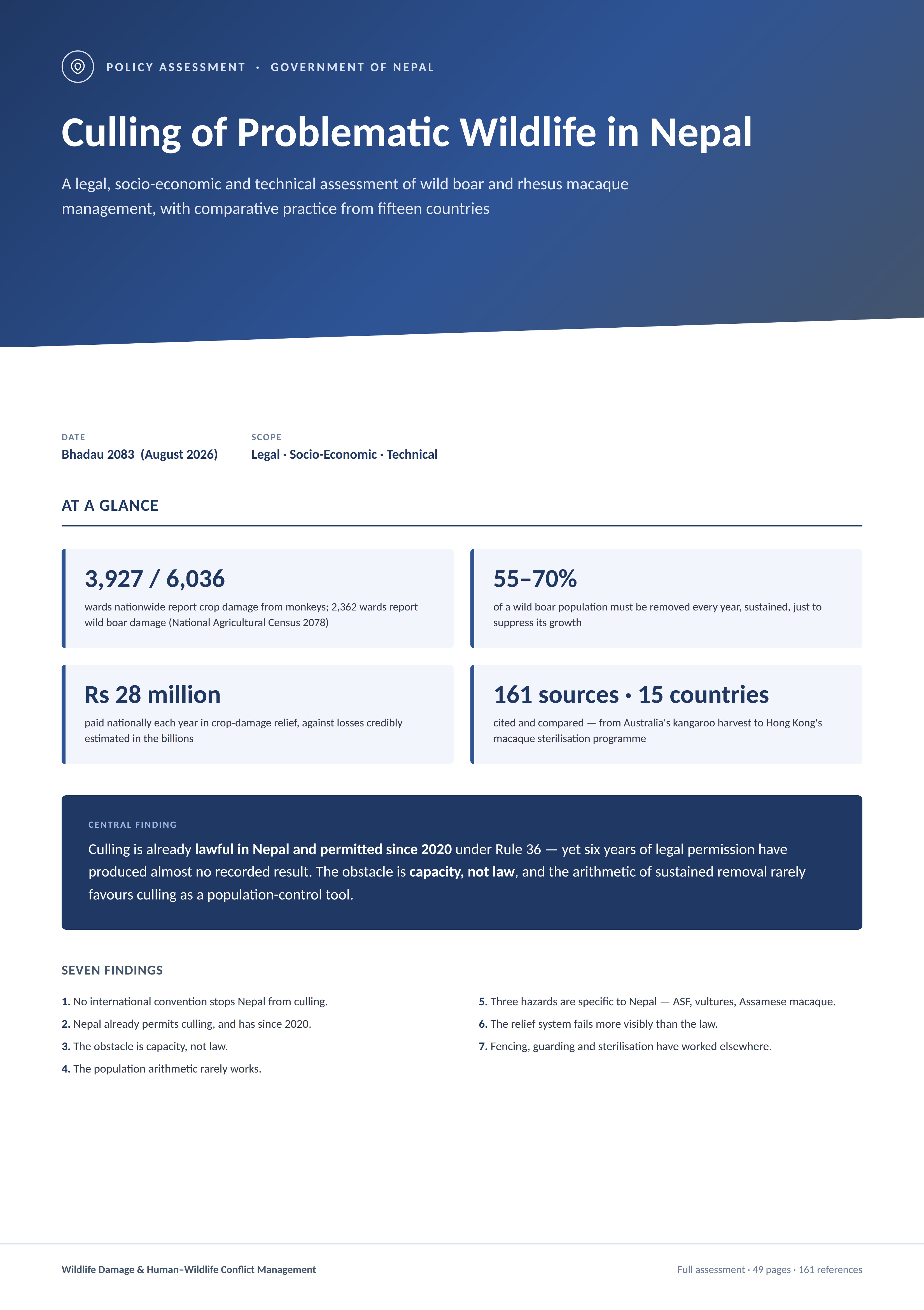
A summary of a new policy assessment on problematic wildlife
Wild boar and rhesus macaque now damage crops across more of Nepal than any other wildlife. The National Agricultural Census 2078 found monkeys causing damage in 3,927 of 6,036 surveyed wards and wild boar in 2,362. Farmers are abandoning land. Members of Parliament have registered an urgent motion. Officials, scientists and local governments are increasingly calling for culling, usually pointing to Australia’s kangaroo harvest or India’s “vermin” declarations.
A recent assessment examined that proposal from three angles — legal, socio-economic and technical — and compared it against culling programmes in fifteen countries. This is a summary of what it found.
Finding 1: No international convention stops Nepal from culling
This is worth settling, because the opposite claim circulates widely.
Nepal is a party to the CBD, CITES, Ramsar and the World Heritage Convention. None of them regulates the domestic killing of native wildlife. CBD Article 3 affirms each state’s sovereign right to manage its own resources. Target 4 of the Kunming-Montreal Global Biodiversity Framework goes further and obliges parties to “effectively manage human-wildlife interactions to minimize human-wildlife conflict for coexistence.”
CITES governs international trade, not domestic take. Wild boar is not listed in any CITES appendix at all. Macaques are Appendix II, which matters only if a specimen crosses the border — and there the constraint is real: exporting macaque products would require a non-detriment finding that is very hard to make while reducing the population, and a legal-acquisition finding that fails outright if the animals were killed without proper domestic authority. Nepal is not a party to the CMS, and cannot join the Bern Convention, which is a European instrument.
Finding 2: Nepal already permits culling, and has since 2020
Rule 36 of the National Parks and Wildlife Conservation Rules, 2030 allows the Government to declare any unprotected species harmful to agriculture, in a specified area for a specified period, by Gazette notice.
Wild boar has been declared under that power repeatedly since Magh 2076 (February 2020), most recently on 23 February 2026. Rhesus macaque was declared for the first time in Magh 2081 and again on 29 Magh 2082. Under those notices, a farmer may already drive away, capture or kill the declared animal on private fields, threshing floors and orchards without prior permission.
Section 11 of the Act and Rule 9 also allow district hunting licences, which is exactly what Arghakhanchi Division Forest Office issued on 23 August 2026 for wild boar, barking deer and spotted deer.
So the question facing Nepal is not whether to permit culling. It is why six years of permission has produced almost no recorded result.
Finding 3: The obstacle is capacity, not law
Arghakhanchi has four valid private firearm licences in the entire district, and the Chief District Officer has stated there is no legal provision to issue more.
India’s experience is the same at larger scale. Himachal Pradesh declared rhesus macaque vermin across 93 tehsils in 2016. Official forest department records show five monkeys were killed in the whole period the order was in force. Kerala delegated shooting powers down to panchayat presidents and gets better results, but depends on roughly 250 licensed shooters paid ₹1,500 an animal — who boycotted the programme in February 2026 over a licensing dispute, halting it.
A law that authorises killing without producing trained operators, payment, disposal capacity or supervision is an announcement rather than a programme.
Finding 4: The arithmetic does not work
To suppress a wild boar population, between 55 and 70 per cent of it must be removed every year, sustained. Modelling of an isolated population shows a 20 per cent annual cull achieves nothing. Where animals can move in from surrounding land — every mid-hill landscape in Nepal — the ceiling is around a 50 per cent reduction even at 60 per cent cull intensity.
The comparative record bears this out:
- Spain: annual hunting bag rose fourteenfold between 1985 and 2022, from 32,000 to 450,000 animals. The population grew.
- Japan: set a target to halve deer and boar by 2023. By 2023 deer were up 5.6 per cent and boar down 6.9 per cent. The deadline moved to 2028.
- Italy: two studies found no significant relationship between the number of boar removed and the amount of crop damage or compensation paid.
Heavy hunting also makes boar harder to control. Under sustained pressure their generation time falls from 3.6 years to 2.3, and the population continues growing at 11.5 per cent a year.
For macaques the risk is not just futility. Killing a troop leader fragments the troop, and the fragments disperse into new areas and behave more aggressively. Japan tripled its macaque cull to over 20,000 a year while macaque distribution expanded by 150 per cent. British badger trials provide the clearest proof of the mechanism: partial culling produced a 27 per cent increase in the target problem, concentrated on land 1–5 km outside the culled area.
The practical warning for Nepal is that ward-by-ward culling without landscape coordination will move damage to the neighbouring palika.
Finding 5: Three hazards specific to Nepal
African swine fever is already established here — 48 outbreaks between 2022 and 2025, an estimated 70,000 pig deaths, roughly USD 20 million in losses, and confirmed in a wild boar at Shuklaphanta in February 2023. Mass drive hunting is now understood to disperse the virus through contaminated boots, vehicles and gralloch.
Vultures. Nepal’s Gyps recovery — white-rumped vultures growing at 22 per cent a year since 2013 — depends on a network of feeding sites where carcasses are deliberately left in the open. In April 2021 a single poisoned-bait incident in Nawalparasi killed 67–69 vultures. Any toxicant programme, or any programme leaving carcasses in fields, targets that system directly.
Assamese macaque is protected under Schedule 1 of the Act, with a penalty of five to fifteen years. It shares much of the mid-hill range with the rhesus and is hard for an untrained person to distinguish. A general permission to kill “monkeys” effectively invites farmers into a serious offence.
Finding 6: The relief system is failing more visibly than the law
Nepal pays around Rs 28 million a year nationally in crop and stored-grain relief, against losses credibly estimated in the billions.
In Madhesh Province, 14,821 human-wildlife conflict cases were recorded in one year. Across two fiscal years, 101 people received relief, and exactly one claim was approved for wild boar damage. Applicants must assemble twelve document types plus a ward recommendation for a payment capped at Rs 10,000. Divisional Forest Offices report receiving claims but no budget. A 2026 survey found roughly 80 per cent of affected farmers did not know the scheme existed.
Finding 7: What has actually worked, elsewhere, on these species
- Hong Kong has sterilised macaques since 2007. The birth rate fell from about 60 per cent to 30 per cent and the population has held flat at roughly 2,000 for sixteen years.
- Himachal Pradesh sterilised over 140,000 macaques; its population fell from 317,512 in 2004 to about 136,000 in 2019. Sterilisation outlasted the vermin order and continues regardless of the animal’s legal status.
- A Japanese design — nine electrified wires to 1.7 m with 45 mm nylon mesh over the full height — excluded wild boar, sika deer and Japanese macaques completely in field trials. Nepal’s own 17 km solar fence at Bahundangi, Jhapa cut conflict incidents by 96 per cent and crop losses by 93 per cent against elephants.
- Hong Kong’s boar programme shows the true cost of effective lethal control: USD 13.5 million over four years, with monthly professional operations, to halve one confined population.
What the assessment recommends
The central recommendation is a change of objective: damage reduction, not population reduction. Nepal cannot achieve the offtake that would shrink a boar population, cannot afford to measure whether it has, and would face compensatory breeding and immigration if it tried. Barriers, guarding and working compensation reduce damage immediately, whatever the population.
On that framing, the package is:
- Replace the blanket annual Rule 36 declaration with a conditional derogation regime — serious damage demonstrated, no satisfactory alternative, no detriment to the population, a named authorising officer, specified methods and a compulsory dated return. The model is EU Habitats Directive Article 16 and the US cormorant permit rule.
- Exclude Assamese macaque absolutely, require species-identification training, and replace the general farmer permission for monkeys with a right to drive away and capture.
- Build a small professional Wildlife Damage Control Service holding firearms under departmental authority.
- Prohibit all toxicants and lead ammunition in the instrument itself, along with aerial shooting, macaque translocation and any trade in carcasses.
- Reform relief first — one form, photographic and ward verification, a statutory 30-day payment deadline, ring-fenced budget reaching all 84 Divisional Forest Offices, and payment conditional on a prevention measure being in place.
- Fund exclusion and paid guarding at scale, with maintenance budgeted from day one, since maintenance failure is the dominant failure mode worldwide.
- Sustained macaque sterilisation, building on the Diktel pilot in Khotang, understood as a fifteen-year instrument rather than a quick fix.
- Run all of it as a three-year, six-district paired pilot with control wards, an independent evaluator and a published stopping rule.
Indicative cost is Rs 1.2–1.5 billion over three years, against the Rs 411.1 million already allocated to the Human–Wildlife Coexistence programme in FY 2083/84. for details study whole report (https://docs.google.com/document/d/14ZeG46pptRBCsOrwzfPXlcjVcXBngxtW/edit?usp=drive_link&ouid=109830323629584646697&rtpof=true&sd=true)